
The Land & Environment Court’s latest decision in the compulsory acquisition space has provided further refinement of how acquiring authorities and dispossessed owners are to identify the “public purpose” for which land is acquired when assessing compensation.
Tallawong Ridge Pty Ltd v Blacktown City Council [2026] NSWLEC 1163, delivered yesterday, follows closely on the heels of the Goldmate Property Luddenham No 1 litigation (which went from the LEC to the Court of Appeal and back) and UPG 72 Pty Ltd v Blacktown City Council [2025] NSWLEC 29. Those cases similarly dealt with the identification of the public purpose as their key issue.
By following those recent decisions in Tallawong, Kempthorne AC found firmly in favour of the Applicant and its narrower interpretation of the public purpose. As a result, compensation was determined in the sum of $12,768,020, comprised primarily of market value.
Background
The acquired land formed part of a broader holding being developed for a 64-lot residential subdivision on Tallawong Road in Rouse Hill. That holding is depicted below (taken from the judgment), with the acquired land, which had been identified as a public park in the subdivision development consent, inset within it.
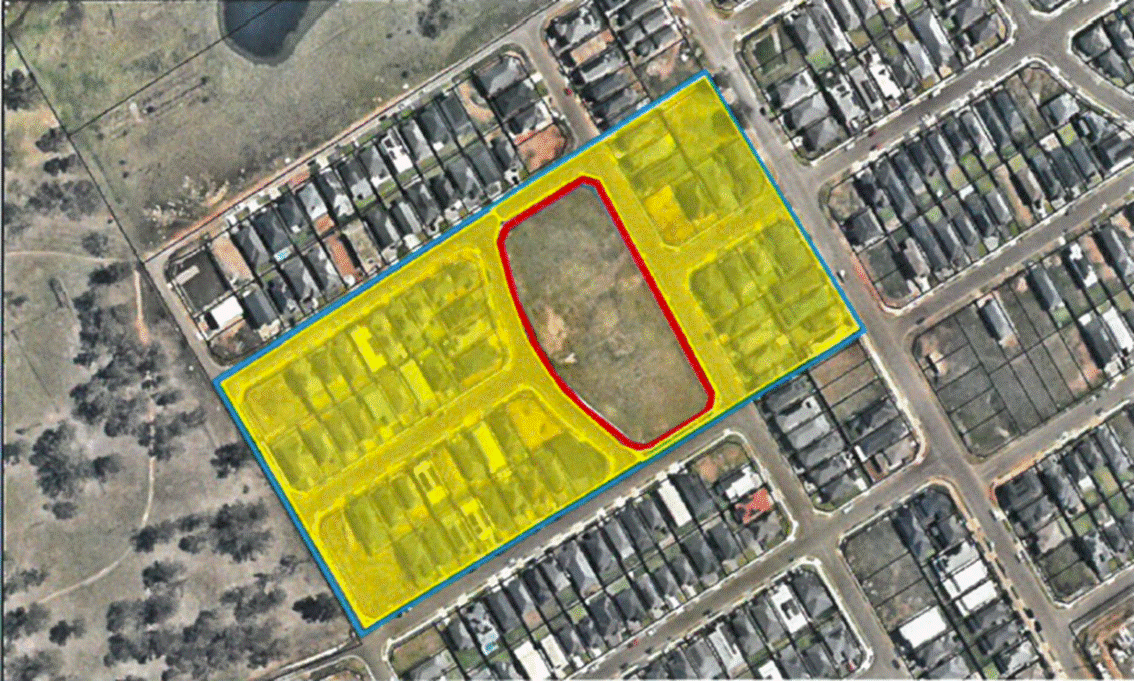
The NSW Valuer-General originally determined compensation in the sum of $6,484,620.91. The Respondent Council contended for a sum in the order of $3,700,000 at hearing.
The dispute turned on two primary factors:
- The identification of the public purpose for which the subject land was acquired, for the purpose of the statutory disregard in determining market value.
- The underlying zoning the acquired land, absent the public purpose.
On the date of acquisition, the land was zoned RE1 – Public Recreation pursuant to the State Environmental Planning Policy (Precincts-Central River City) 2021 (Precincts SEPP). The acquisition notice effecting the acquisition stated that the land was acquired for “public recreation”.
The parties’ positions
The Applicant contended that the public purpose was public open space and that the underlying zoning was R2 Low Density Residential (being the zoning of the land surrounding the acquired land pursuant to the Precincts SEPP).
The Respondent contended that the public purpose was “the partial provision of essential infrastructure to meet the needs of a growing residential community in the surrounding area” (at [41]) and that the underlying zoning was RU4 Primary Production Small Lots, being the previous zoning of the acquired land pursuant to the Blacktown Local Environmental Plan 2015 prior to its rezoning in March 2022.
During the hearing, the parties agreed on an amount of compensation for disturbance costs payable pursuant to sections 59(1)(a) and (b) of the Land Acquisition (Just Terms Compensation) Act 1991 in the sum of $51,018.93. As such, market value under section 55(a) was the focus of the hearing, evidence and judgment.
Evidence, and the Respondent’s distinction from Goldmate
To address the Court’s conclusions in Goldmate and UPG 72, which prima facie supported the Applicant’s interpretation of the public purpose, the Respondent Council argued that:
- while the Council did not have the power to rezone land, it participated in a detailed, collaborative process of which a rezoning was the product;
- the acquired land was the only land that could ever realistically have provided the public open space for the residential zoning in the surrounding area under the Precincts SEPP;
- the “use” of the acquired land as a park was not the same as the “purpose” for which it was acquired – that purpose being a broader, strategic one of which the park was only part; and
- the need for public open space generated by the rezoning of the surrounding land was what facilitated the rezoning of the acquired land in the first place, and so if the acquired land did not serve that need, its underlying zoning was only RU4.
Both parties addressed these key issues through extensive town planning, and then later valuation and quantity surveying (QS), evidence, including a total of five joint expert reports and two expert reports from the parties’ joint QS expert.
Case law findings
Ultimately, the Court found that UPG 72 (being a decision relating to land in the same general precinct and subject to similar zoning principles) was largely determinative of the key issues. At [83]-[87] Kempthorne AC, quoting Pepper J in UPG 72, held:
[83] At [145] and [146] of UPG 72, Pepper J, made the following findings:
“145 But this range of functions, broad as it is, does not include that of releasing or rezoning land for urban purposes. That act was carried out by the NSW Government pursuant to the promulgation of the Growth Centres SEPP and cl 276 of the EPA Regulations. If there was a ‘vehicle’ by which the NSW Government achieved the overall purpose of urban release, it was not the Council, it was the GCC. The Council was not authorised to acquire the land for this purpose. None of its functions include the release of land. The release of land is not a function of the Council, but is a function of the NSW Government. Irrespective of the breadth of the text of s 186(1) of the Local Government Act, its meaning is not so elastic that almost all functions of the NSW Government fall within (the logical corollary of the Council’s argument).
146 The land was therefore not acquired for the public purpose of the rezoning of the precincts identified in the Growth Centres SEPP or as part of the urban release of land in Western Sydney in 2004 and continuing. The Council had no power under the Local Government Act, or any other Act to which the Court was taken, to acquire land for this purpose.”
…
[85] In these proceedings, the respondent contends that the acquisition of the acquired land extended the public purpose to being the partial provision of essential infrastructure to meet the needs of a growing residential community in the surrounding area, which is a similar argument it proposed in the UPG 72 case as seen in the second sentence of [140] quoted at [82] of this judgment above which I repeat here for reasons of clarity: “It was clear that in rezoning the Riverstone Precinct, releasing it pursuant to the Growth Centres SEPP and by nominating the Council as the acquiring authority for drainage land, public reserves and other land, it was intended that the Council play a critical role in delivering the essential public works necessary for the urban release”, as argued by the respondent.
…
[87] Pepper J, at [145] and [146] of UPG 72 quoted above at [83], clearly rejected this argument.
Further, at [92]-[93]:
[92] Turning to the purpose of the acquisition, the acquisition notice simply states that the public purpose is public recreation. It does not say in the acquisition notice, to use words that are used similarly by Mr Mitchell and Mr Shearer, “….the partial provision of essential infrastructure to meet the needs of a growing residential community in the surrounding area”.
[93] Therefore, based on the decisions of Preston CJ in Goldmate and Pepper J in UPG 72, the respondent’s arguments that the public purpose can be extended or can be broadened to include being partial provision of the essential infrastructure to meet the needs of a growing residential community in the surrounding area fails and must be rejected.
Kempthorne AC also cited factual and expert town planning evidence to the effect that the acquired land was not the only land that could have provided public open space for the precinct.
Development costs
The parties’ joint QS expert provided evidence as to the likely costs associated with a hypothetical development of the acquired land in accordance with an underlying R2 zoning. In doing so, that expert identified a number of costs which, when adjusted in varying combinations, produced seven cost scenarios that were considered by the parties’ valuation experts. However, the valuation outcomes in those seven scenarios (all predicated on an assumed underlying R2 zoning) were not significantly different, with the lowest (and the Respondent’s preferred) sum being $12,606,000 and the highest (and the Applicant’s preferred) sum being $12,717,000.
Following cross-examination of the joint QS expert, and in dismissing the Respondent’s argument that it was prejudiced by the relatively late receipt of that expert’s supplementary report, Kempthorne AC accepted the Applicant’s preferred position.
Compensation was therefore determined in the total sum of $12,768,020. No order was (or could be – see rule 3.10 of the Land and Environment Court Rules 2007) made as to costs.
Concluding comments
While Tallawong is, for the most part, a logical product of the precedents set in Goldmate and UPG 72, it provides useful, further clarity on a number of possible arguments that could arise in the context of a common acquisition scenario for local Councils; i.e. land that is acquired in freehold to deliver RE1-zoned land within a broader, primarily residential precinct.
This provides further guidance for dispossessed owners and Councils alike in dealing with future land acquisitions of this kind.
Beatty Hughes & Associates are experts in compulsory acquisition law. If you would like to discuss the above decision, or another matter pertaining to land acquisition in Australia, Please feel free to get in touch.